

Why Namibia Feels Like Another Planet You Can Actually Fly To
There are destinations that feel remote, and then there is Namibia. A country so visually stripped back and geographically expansive that it feels less like a place you arrive in and more like a system you enter. A slow dissolving of noise, urgency, and clutter.
For commercial airline travellers, Namibia offers something increasingly rare in global tourism: immediate spatial silence. Not metaphorical silence, but literal, physical quiet that begins the moment you leave Windhoek’s runway and continues outward into landscapes that refuse to be busy.
This is not just a safari destination. It is a fly-in geography of emptiness, scale, and surreal clarity. And Windhoek, modest and orderly, becomes the threshold to it all.
Windhoek as a Gateway, Not a Destination
Most capital cities announce themselves loudly. Windhoek does the opposite. It functions less as a centre of gravity and more as a controlled entry point into vastness.
For travellers arriving via commercial airlines, the city is strategically positioned. Hosea Kutako International Airport sits about 40 kilometres outside the city, a quiet buffer zone that already hints at Namibia’s relationship with space. There is no gradual easing into the country’s drama. You land, you transition, and within an hour you are already dissolving into desert corridors or heading toward smaller regional airstrips.
Windhoek’s role in modern tourism is increasingly defined by logistics rather than spectacle. It is a staging ground for fly-in safaris, charter connections, and overland redistribution. From here, Namibia unfolds like a map being unrolled slowly across sand.
And unlike many African hubs, the transition is frictionless. The aviation infrastructure supports a smooth handover from international carriers to regional bush flights, making the country unusually accessible for a destination that feels so remote.
The Geography of Silence Tourism
Silence tourism is not an official category, but Namibia effectively defines it.
This is a country where sound behaves differently. Wind moves without obstruction. Distance absorbs noise before it accumulates. Even human presence feels diluted by scale.
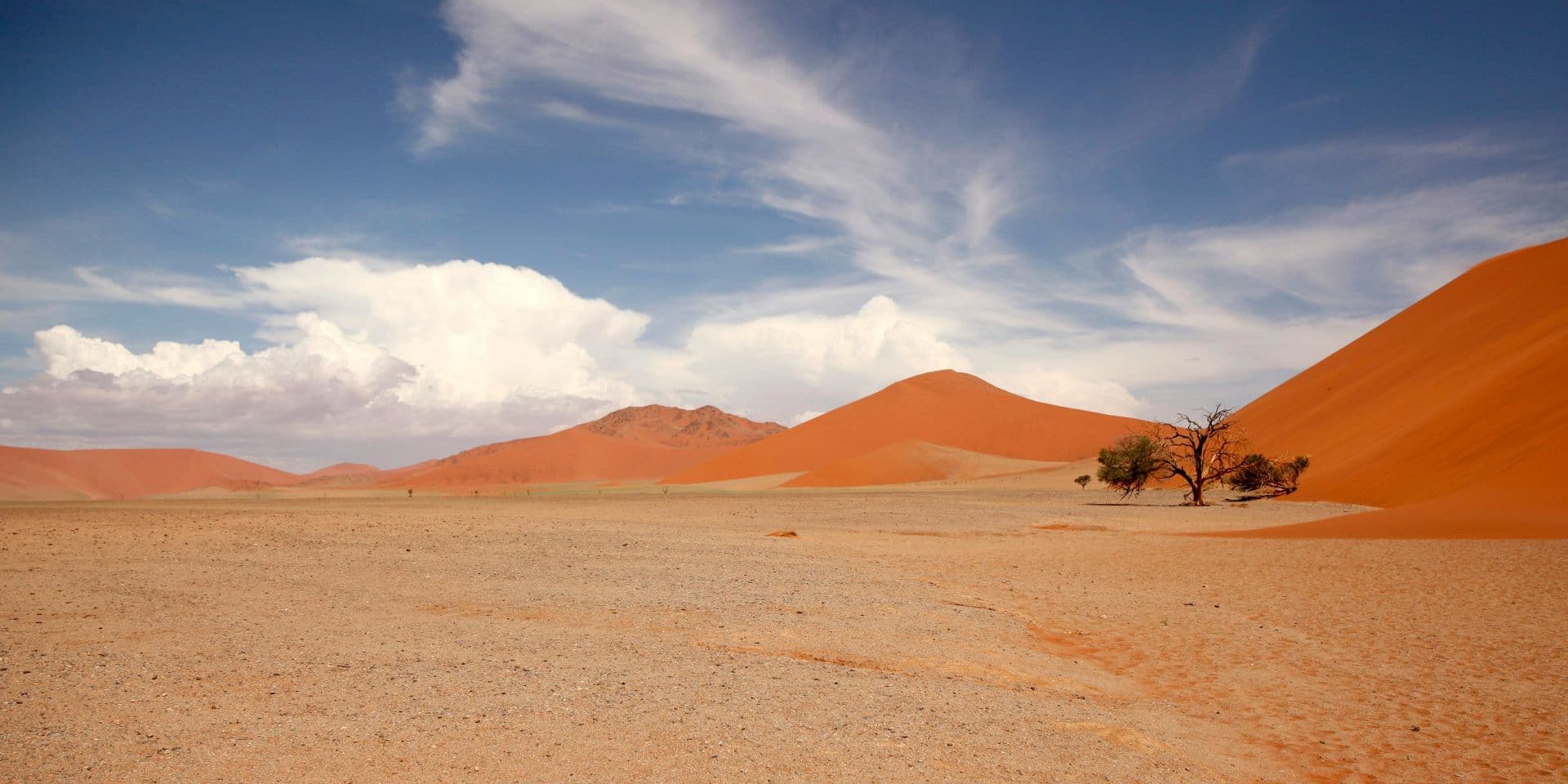
The Namib Desert stretches along the Atlantic coast like an ancient boundary between land and imagination. Inland, the terrain opens into gravel plains, mountain islands, and fossilised river systems that rarely carry water but always carry memory.
Flying over Namibia reveals this immediately. On a short charter hop, the landscape stops behaving like terrain and starts behaving like abstraction. Colour fields replace detail. Shadows stretch like slow ink spills across stone. The sense of motion becomes internal rather than external.
Commercial airline tourism typically focuses on arrival convenience. Namibia adds something unusual: arrival as transformation.
Fly-In Travel as the Natural Way to Experience Namibia
In most destinations, fly-in travel is a luxury add-on. In Namibia, it is the most rational way to exist within the geography.
Road networks are extensive but distances are deceptive. A straight line on a map can become hours of gravel, heat shimmer, and near-empty horizon. Air travel collapses these distortions.
Small aircraft connect Windhoek with remote airstrips near Sossusvlei, Etosha, Damaraland, and the Skeleton Coast. These flights are not just transfers. They are narrative transitions. Each leg of the journey feels like turning a page in a book written in sand and stone.
From a commercial airline perspective, Namibia’s aviation ecosystem functions as a layered system:
International carriers bring travellers into Windhoek
Regional flights distribute them across the country
Charter aircraft complete the final descent into isolation
This structure is what makes Namibia uniquely suited to fly-in tourism. It is not an optional luxury; it is the operational rhythm of the country.
Sossusvlei and the Geometry of Dunes from Above
Few landscapes in the world are as visually decisive as Sossusvlei. From the ground, the dunes are monumental. From the air, they become geometric logic.
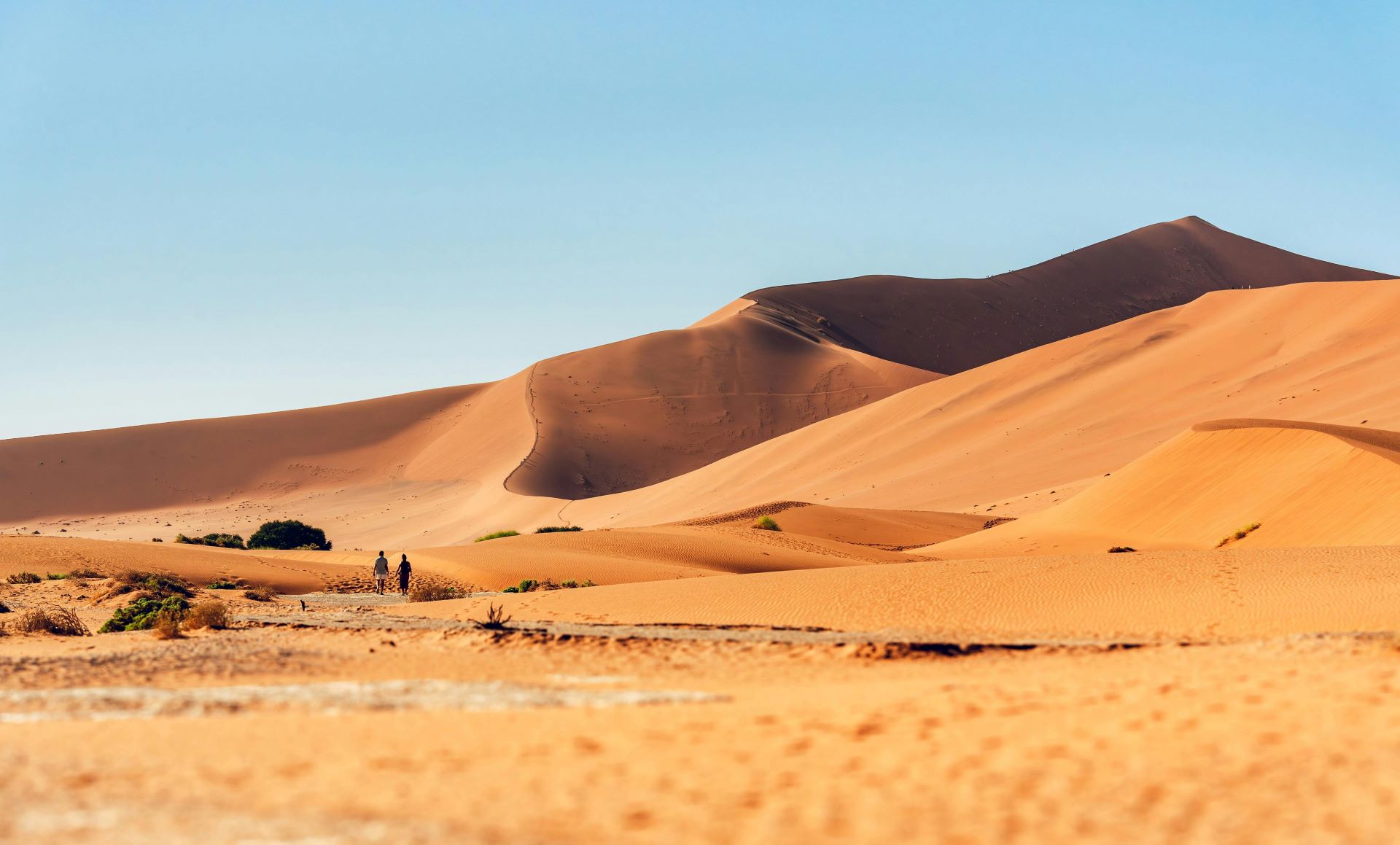
Aerial approaches reveal an abstract desert architecture: long ridges shaped by wind, shifting like slow-moving sculpture. The famous red-orange dunes are not isolated features but part of a continuous system that stretches beyond human perception.
Flying into the Sossusvlei region often involves small aircraft descending over vast salt pans and dune corridors. The landing strips are minimal, almost temporary in feeling, reinforcing the idea that you are entering a space that resists permanence.
Tourism here is not about density of attractions. It is about reduction. The fewer elements present, the more each one matters.
Etosha: A Living System Seen from the Sky
Etosha National Park offers a different kind of visual experience. Unlike the sculpted emptiness of the Namib Desert, Etosha is structured around a central salt pan that behaves like a natural mirror.
From the air, the pan appears as a pale void surrounded by darker ecological activity. Animal movement becomes faint but readable patterns. Waterholes register as small interruptions in the geometry of dryness.
Fly-in access to Etosha transforms the safari concept entirely. Instead of long overland approaches through dust and scrub, travellers are dropped into proximity. The experience shifts from journey-as-endurance to journey-as-observation.
The park becomes not something you arrive at, but something you enter from above.
Skeleton Coast: Where the Ocean Meets Absence
The Skeleton Coast is often described as hostile, but that framing misses its central quality. It is not hostility that defines it, but absence with texture.
Fog rolls in from the Atlantic in slow, deliberate movements. Shipwrecks lie half-consumed by sand. The coastline itself feels like a place where the ocean forgot to finish its sentence.
Aerial travel along this stretch is one of Namibia’s most striking experiences. Commercial airline passengers connecting through Windhoek can transition into charter flights that trace the coast’s entire length in a matter of hours.
From above, the Skeleton Coast is not a collection of sites. It is a continuous atmosphere. A long exhale of land meeting sea.
The Logistics Advantage: Why Airlines Are Key to Namibia
Namibia’s tourism model is deeply dependent on aviation infrastructure. Without it, access would be slow, fragmented, and limited.
Commercial airline routes into Windhoek are the backbone. They connect the country to Johannesburg, Cape Town, Frankfurt, and other global hubs. From there, a network of regional carriers and charter operators takes over.
This structure benefits modern travellers in several ways:
It reduces total travel time across vast distances
It allows multi-destination itineraries without road fatigue
It enables access to remote luxury lodges without overland exposure
In practical terms, Namibia is one of the most efficient long-distance fly-in safari destinations in the world. The perception of remoteness is not matched by logistical difficulty. That contrast is part of its appeal.
Desert Lodges and the Architecture of Isolation
Namibian accommodation design reflects the country’s geography. Lodges are not built to dominate landscapes but to withdraw into them.
Many fly-in lodges are positioned to maximise distance from other human structures. Glass, stone, and canvas are used to frame emptiness rather than interrupt it.
From an aviation perspective, these lodges often function as endpoints for charter routes. A small aircraft lands on a gravel strip, and within minutes travellers transition from aircraft cabin to silence.
The architecture supports a psychological shift. Interiors feel minimal not as a design trend, but as a response to external scale.
Windhoek Revisited: The Return Point That Changes Meaning
Returning to Windhoek after experiencing Namibia’s remote regions often produces a subtle reversal in perception. The city does not feel larger; the wilderness feels more structured.
Commercial airline schedules make this transition smooth. Travellers can move from desert isolation back to international connectivity within a single day.
This is where Namibia’s tourism model shows its sophistication. It does not isolate travellers from global systems. It layers isolation and connectivity in controlled alternation.
Windhoek becomes less of a starting point and more of a calibration zone.
The Psychology of Aerial Distance
Flying over Namibia repeatedly alters perception of scale. Distances that feel vast on the ground compress into manageable segments from the air. Yet at the same time, new forms of vastness appear that cannot be registered from ground level.
This duality is central to fly-in tourism. It creates a layered understanding of geography:
Ground level: tactile, immediate, slow
Air level: abstract, structural, expansive
The combination produces a rare travel experience where movement itself becomes part of the destination.
Why Namibia Works So Well for Commercial Airline Tourism
From an industry perspective, Namibia occupies a unique position. It is both remote and accessible, minimal yet logistically mature.
Commercial airlines benefit from stable demand into Windhoek, driven by tourism circuits that rely on predictable fly-in routes. Tour operators benefit from the efficiency of aircraft-based distribution. Travellers benefit from reduced transit friction across extreme distances.
But beyond economics, Namibia offers something more difficult to quantify. It delivers a travel experience where infrastructure does not overwhelm landscape, and where aviation enhances rather than disrupts environmental immersion.
This balance is rare. And increasingly valuable.
The Future of Fly-In Silence Tourism
As global travel becomes more congested, Namibia’s model may become more influential. Destinations that offer scale without crowding, access without saturation, and movement without chaos are likely to gain prominence.
Fly-in tourism is not just a convenience mechanism in Namibia. It is a design principle embedded into how the country is experienced.
Windhoek remains the hinge. The place where aircraft land, systems connect, and journeys reset. From there, everything opens outward into silence.
And in that silence, Namibia reveals its most unusual quality: it does not ask for attention. It removes everything else until attention has nowhere to go but the landscape itself.